
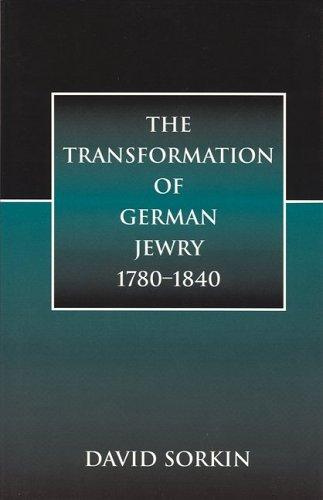
by David Jan Sorkin
The transformation of German Jewry from 1780 to 1840 exemplified a twofold revolution: on one level, the end of the feudal status of Jews as an autonomous community forced them to face a protracted process of political emancipation, a far-reaching social metamorphosis, and growing racial anti-Semitism; yet, on another level, their encounter with the surrounding culture resulted in their own intense cultural productivity. In this ground-breaking study, David Sorkin argues that emancipation and encounter with German culture and society led not to assimilation but to the creation of a new Jewish identity and community--a true and vibrant subculture that produced many of Judaism's modern movements and fostered a pantheon of outstanding writers, artists, composers, scientists, and academics. He contends that German-Jewish subculture was based not, as widely believed, on nationalistic--Jewish versus German--or religious--Jewish versus Christian--disparities, but rather on the struggle for fr

Roald Dahl

Zora Neale Hurston
Indie authors send us advance copies. We match them to readers by genre. You get the book free, the author gets an honest review.