

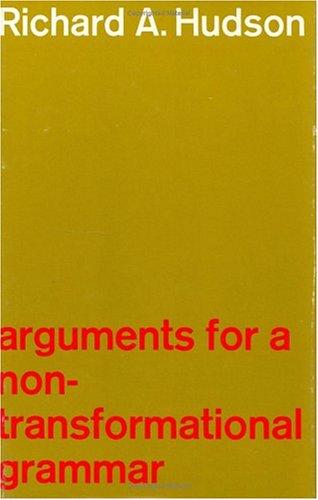
by Richard A. Hudson
For the past decade, the dominant transformational theory of syntax has produced the most interesting insights into syntactic properties. Over the same period another theory, systemic grammar, has been developed very quietly as an alternative to the transformational model. In this work Richard A. Hudson outlines "daughter-dependency theory," which is derived from systemic grammar, and offers empirical reasons for preferring it to any version of transformational grammar. The goal of daughter-dependency theory is the same as that of Chomskyan transformational grammar--to generate syntactic structures for all (and only) syntactically well-formed sentences that would relate to both the phonological and the semantic structures of the sentences. However, unlike transformational grammars, those based on daughter-dependency theory generate a single syntactic structure for each sentence. This structure incorporates all the kinds of information that are spread, in a transformational grammar, ove

Erin Morgenstern
Pierce Brown
Indie authors send us advance copies. We match them to readers by genre. You get the book free, the author gets an honest review.